
Or: not every mid-century piece was about austere restraint
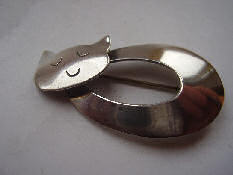
A lot of what defines mid-century modernist jewellery is restraint, clean form, honest material, minimal ornament. This sleeping cat brooch is a reminder that the same designers working in that language were entirely capable of warmth and humour too. It’s figurative rather than abstract, clearly a curled, sleeping cat, but rendered with the same structural, simplified sensibility as the more austere pieces elsewhere in this collection.
Figurative modernist jewellery, animals especially, occupied a real place in mid-century design, not a lapse from the movement’s principles but an extension of them: take a familiar, everyday subject and render it through the same simplified, structural lens applied to purely abstract forms. A sleeping cat, reduced to its essential curled silhouette, is arguably a harder design problem than an abstract geometric brooch, since it still has to read unmistakably as a cat.
Why pieces like this are worth taking seriously. It’s easy to file figurative animal brooches under ‘charming’ and stop there, treating them as lesser than the more austere abstract work. That undersells the actual design discipline involved: simplifying a recognisable, expressive form down to its essentials without losing what makes it recognisable is a genuine skill, not a lesser one.
What to look for. The silhouette should read clearly as a sleeping cat from across a room, not just up close, that’s the actual test of whether the simplification succeeded. This one passes easily.
This piece has since sold. It was part of a small, genuinely personal collection of mid-century and antique jewellery, gathered over years rather than acquired for resale. See the Orb Sterling cat brooch on Gozotiques.