
Or: Germany had its own answer to Scandinavian restraint
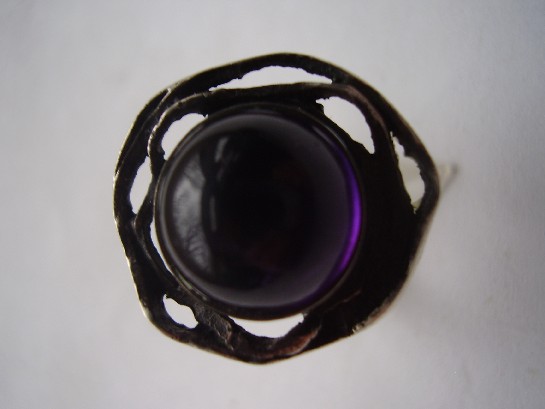
Scandinavian names tend to dominate any conversation about mid-century modernist jewellery, but Germany’s own postwar design culture, shaped heavily by the Bauhaus legacy a generation earlier, produced a genuinely parallel tradition. Function over ornament, structure over decoration, honest material over illusion, the same design commandments, arrived at independently through a different national design history.
This ring shows that lineage clearly: a substantial amethyst held in silverwork that prioritises clean geometric structure over elaborate setting. It’s recognisably part of the same broad mid-century movement as the Scandinavian pieces elsewhere in this collection, while carrying a slightly different design accent, marginally more architectural, less organic, consistent with German design’s own particular inheritance from Bauhaus functionalism.
Why the Bauhaus connection matters here. The Bauhaus movement formally ended in 1933, but its core design principles, strip away ornament, let function and material dictate form, didn’t disappear with it. They resurfaced across German craft and product design for decades afterward, jewellery included. A ring like this carries that inheritance whether or not its maker ever set foot in the original school.
What to look for. The amethyst should be securely and cleanly set within the geometric silverwork, with no gaps or crude soldering visible, exactly what separates genuine period craftsmanship from a rougher reproduction. This one is cleanly made.
This piece has since sold. It was part of a small, genuinely personal collection of mid-century and antique jewellery, gathered over years rather than acquired for resale. See the German Modernist ring on Gozotiques.