A German Modernist Silver and Amethyst Ring: The Bauhaus Instinct in Miniature

Or: Germany had its own answer to Scandinavian restraint
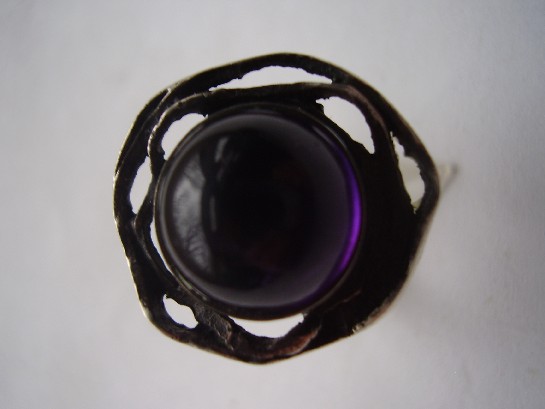
German Modernist silver and amethyst ring

Scandinavian names tend to dominate any conversation about mid-century modernist jewellery, but Germany’s own postwar design culture, shaped heavily by the Bauhaus legacy a generation earlier, produced a genuinely parallel tradition. Function over ornament, structure over decoration, honest material over illusion, the same design commandments, arrived at independently through a different national design history.

This ring shows that lineage clearly: a substantial amethyst held in silverwork that prioritises clean geometric structure over elaborate setting. It’s recognisably part of the same broad mid-century movement as the Scandinavian pieces elsewhere in this collection, while carrying a slightly different design accent, marginally more architectural, less organic, consistent with German design’s own particular inheritance from Bauhaus functionalism.

Why the Bauhaus connection matters here. The Bauhaus movement formally ended in 1933, but its core design principles, strip away ornament, let function and material dictate form, didn’t disappear with it. They resurfaced across German craft and product design for decades afterward, jewellery included. A ring like this carries that inheritance whether or not its maker ever set foot in the original school.

What to look for. The amethyst should be securely and cleanly set within the geometric silverwork, with no gaps or crude soldering visible, exactly what separates genuine period craftsmanship from a rougher reproduction. This one is cleanly made.

This piece has since sold. It was part of a small, genuinely personal collection of mid-century and antique jewellery, gathered over years rather than acquired for resale. See the German Modernist ring on Gozotiques.
A K & E Carlson Cesons Amethyst Pendant Bracelet: Sweden’s Lesser-Known Silver House

Or: the maker’s mark that takes real digging to place

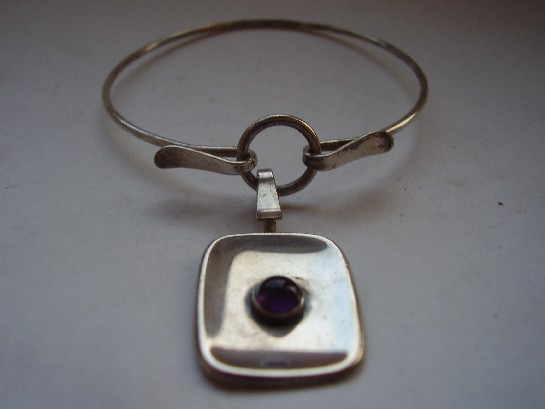
K and E Carlson Cesons silver amethyst pendant bracelet

Not every mid-century Scandinavian workshop left the kind of documentation trail that David Andersen or Georg Jensen did. K & E Carlson, working under the Cesons mark, is one of the harder Swedish houses to research in real depth, the kind of name that turns up reliably on genuine period pieces but doesn’t have a tidy Wikipedia page waiting to explain it. That’s not a flaw in the piece, it’s just the reality of how much mid-century Scandinavian craft production has never been fully catalogued.

This bracelet, built around an amethyst pendant, shows all the hallmarks of the wider Swedish silver tradition of the period, clean structural setting, honest silverwork, a stone chosen and cut to suit the design rather than simply maximise size. It sits comfortably alongside better-documented names from the same era and country without needing their name recognition to justify the craftsmanship.

Why under-documented makers are worth collecting anyway. A piece doesn’t need a famous name attached to be a genuine, well-made example of its period and movement. If anything, tracking down exactly who Cesons was is part of what makes a piece like this interesting to actually own, rather than just display.

What to look for. The Cesons mark itself, alongside standard Swedish silver hallmarks, is the main way to verify a piece like this, both are clear and legible here.

This piece has since sold. It was part of a small, genuinely personal collection of mid-century and antique jewellery, gathered over years rather than acquired for resale. See the K & E Carlson bracelet on Gozotiques.

A Kupittaan Kulta Silver and Labradorite Torque: Elis Kauppi at His Most Ambitious

Or: what happens when a Finnish goldsmith stops making jewellery and starts making sculpture you can wear

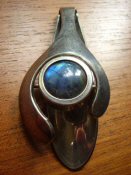
Kupittaan Kulta silver and labradorite torque and pendant

A torque, structurally, is one of the oldest jewellery forms there is: a rigid, near-circular band worn around the neck, traceable back to Iron Age Europe. What makes this piece remarkable is what Elis Kauppi does with that ancient form. Rather than treating it as a simple hoop, he builds it as a substantial, sculptural silver structure set with labradorite, the stone that shows a shifting flash of blue and green depending on the angle of light, and turns a genuinely old idea into something that reads as pure 1960s Scandinavian modernism.

Why this is a step beyond his other work in this collection. Kauppi’s pendants and rings, several of which are elsewhere in this collection, show his kinetic and structural instincts at a relatively modest scale. A torque this substantial is a different proposition entirely, more silver, more engineering, more physical presence on the body. It’s the kind of piece a designer makes when they’ve fully mastered the smaller forms and want to see how far the same ideas scale up.

Why labradorite, specifically. The stone’s shifting colour play, known as labradorescence, rewards exactly the kind of bold, structural setting Kauppi favoured. A small stone in a delicate setting would waste the effect; a substantial cabochon set into serious silverwork lets the colour genuinely move as the wearer does, which ties directly back to Kauppi’s broader interest in jewellery that responds to motion rather than sitting inert.

What to look for. The labradorescence should shift visibly as the piece is turned in the light, a flat, static-looking stone is a sign of a lower grade of material. This one shows the effect clearly.

This piece has since sold. It was part of a small, genuinely personal collection of mid-century and antique jewellery, gathered over years rather than acquired for resale. See the Kupittaan Kulta torque on Gozotiques.

Elis Kauppi’s Kinetic Amethyst Pendant: Finnish Modernism That Actually Moves

Or: the Finnish goldsmith who put jewellery in motion

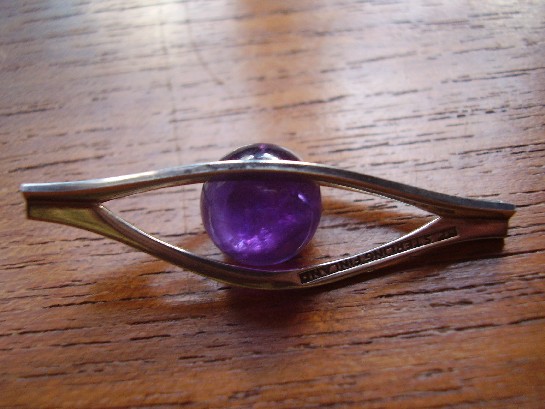
Kupittaan Kulta Elis Kauppi Kinetic Amethyst Eye of Horus Pendant

Most jewellery sits still. Elis Kauppi’s didn’t. Founder of Kupittaan Kulta in Turku, Finland, Kauppi became one of the defining names in Scandinavian modernist silverwork through the 1950s and 60s, and one of his signatures was kinetic construction, pieces with parts that genuinely swing, rotate, or shift as the wearer moves, rather than sitting as fixed ornament.

This pendant, worked around an amethyst cabochon, carries that same restless quality. Scandinavian modernism of this period was reacting hard against ornate, traditional goldsmithing, favouring clean structural forms and a real relationship between metal and stone rather than the stone simply being mounted onto it. Kauppi’s kinetic pieces push that a step further: the design isn’t finished until someone is actually wearing it.

Why Finland, specifically. Finnish silver design in this era had real international standing, part of the broader Scandinavian design wave that shaped how the whole world thought about modern jewellery, alongside Georg Jensen in Denmark and a handful of other studios. Kupittaan Kulta pieces from this period are genuinely collected, not just old stock.

What makes this one worth having. Kinetic elements are also the first thing to fail on a worn or poorly maintained piece, so a mechanism that still moves smoothly after this many decades says something real about how it’s been kept. This one still does exactly what Kauppi built it to do.

This piece has since sold. It was part of a small, genuinely personal collection of mid-century and antique jewellery, gathered over years rather than acquired for resale. See the Kupittaan Kulta pendant on Gozotiques.