
Or: how a Dominican immigrant turned scrap copper into a design movement
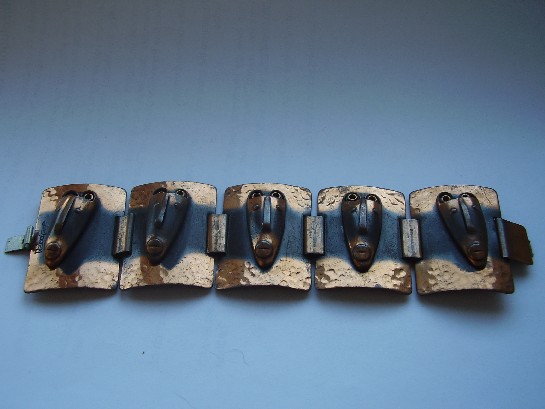
In the 1930s, Frank Rebajes arrived in New York from the Dominican Republic with almost nothing, and started hand-forming copper jewellery on the street. By the 1950s, his Greenwich Village studio was one of the best-known names in American modernist metalwork, copper and brass pieces sold everywhere from his own shop to major department stores, worn by people who wanted something that looked nothing like traditional fine jewellery.
This bracelet is a good example of exactly what made his work distinctive. Five stylised faces, hammered and patinated copper, linked into a single articulated band. It’s not trying to be subtle. Rebajes’ whole design language ran on bold, abstracted forms rather than delicate detail, closer in spirit to the primitivist and folk-art influences popular in mid-century design than to anything from a traditional jeweller’s bench.
Why copper, specifically. Copper was cheap, workable by hand, and took a patina beautifully, all of which mattered to a designer building a business from nothing. It also meant Rebajes pieces were affordable enough to actually sell in volume, which is part of why they turn up reasonably often today, and part of why a genuine, well-preserved piece like this is still worth having: this was democratic design, made to be worn, not locked away.
What to look for. Genuine Rebajes pieces are usually stamped, and the patina should look earned rather than artificial, uneven, settled into the recesses of the hammering rather than a flat, uniform tone. This piece carries exactly that kind of honest age.
This piece has since sold. It was part of a small, genuinely personal collection of mid-century and antique jewellery, gathered over years rather than acquired for resale. See the Frank Rebajes Copper Face Bracelet on Gozotiques.