
A Sterling Canada Goose Brooch, Maker Marked WJM: A Piece Worth Researching Further

Or: an honest piece about what’s known and what genuinely isn’t

This sterling silver brooch, depicting a Canada goose, carries a maker’s mark reading WJM. North American silversmithing has a long and genuinely significant tradition among Indigenous makers across many distinct nations, each with its own techniques, motifs, and history, and this piece’s listing describes it as part of that broader tradition. Rather than guess at a specific attribution I can’t verify from the mark alone, the honest thing to say is that WJM is worth researching properly, ideally by someone with real expertise in Indigenous North American silverwork marks, before making any confident claim about which maker or nation it traces to.

What can be said with confidence: the piece is sterling silver, the goose is rendered with real anatomical attention rather than a generic decorative bird shape, and the maker clearly cared enough about attribution to stamp the work rather than leave it anonymous. That alone makes it worth more careful research rather than a confident story built on too little evidence.

Why getting this right matters more than usual. Indigenous silverwork has a real, well-documented history of misattribution and outright fraud in the wider antiques market, generic pieces sold under invented or borrowed maker names. The respectful and accurate approach here is to present what’s actually known, a genuine maker’s mark and a well-made sterling piece, without inflating that into a specific claim the mark alone doesn’t support.

What to look for. The WJM mark is clear and legible on this piece, which is exactly what makes it possible to research properly, an illegible or absent mark would make verification essentially impossible.

This piece has since sold. It was part of a small, genuinely personal collection of antique jewellery, gathered over years rather than acquired for resale. See the sterling goose brooch on Gozotiques.

[Image pending, to be added once source photo is confirmed.]
A Gorgeous Apollo Studios New York Cherry Ice Bucket: Mid-Century American Barware

Or: modernist design didn’t stop at jewellery, it ran the whole cocktail cart

Everything else in this collection is jewellery, and this piece is a useful reminder that the same mid-century design instincts, honest material, bold simplified form, real craft applied to everyday objects, ran through entertaining and barware just as much as through what people wore. Apollo Studios, working out of New York, applied a cherry motif to this ice bucket with exactly the same confident, decorative modernism found in the era’s best jewellery design.

Mid-century entertaining had its own genuine design culture, cocktail shakers, ice buckets, serving pieces, all treated as objects worth real design attention rather than purely functional afterthoughts. A well-made piece like this one sat at the centre of postwar American hospitality the way a good coffee table or credenza sat at the centre of the room around it.

Why barware collecting is its own genuine category. Mid-century barware gets far less serious collector attention than furniture or jewellery from the same period, despite often showing the same level of design ambition. That gap between attention and actual quality is exactly where a piece like this offers real value to anyone actually looking rather than just following the crowd.

What to look for. The cherry motif’s detailing should be crisp and the metal finish free of significant pitting or corrosion, both signs of a piece that’s been kept properly rather than left in damp storage. This one is in genuinely good condition.

This piece has since sold. It was part of a small, genuinely personal collection of mid-century antiques, gathered over years rather than acquired for resale. See the Apollo Studios ice bucket on Gozotiques.

[Image pending, to be added once source photo is confirmed.]
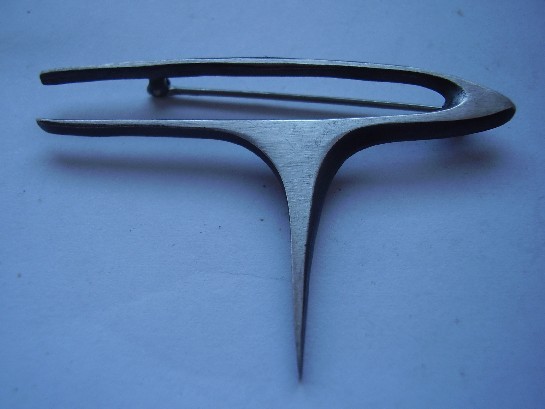
An Esther Lewittes Sterling Brooch: American Studio Jewellery’s Quiet Corner

Or: modernism in America wasn’t only happening in Rebajes’ Greenwich Village workshop

Esther Lewittes sterling brooch

Frank Rebajes gets most of the attention when American mid-century modernist jewellery comes up, and deservedly, but he wasn’t working alone. A wider community of American studio jewellers, Esther Lewittes among them, were producing sterling silver work through the same period, applying the same broad modernist instincts, structural form, honest material, minimal ornament, without necessarily building the same level of commercial fame.

This brooch is a genuine example of that wider studio jewellery movement, American mid-century modernism as a real, broad-based craft culture rather than the output of one or two famous names. It’s worked in sterling rather than Rebajes’ signature copper, which itself says something: not every American modernist workshop was chasing the same affordable-material strategy, some worked in precious metal from the start.

Why the wider studio movement matters, not just the famous names. American studio jewellery in this period was genuinely decentralised, small workshops and individual makers across the country, not one dominant style radiating out from a single figure. Understanding that wider context is part of what makes a single well-attributed piece like this genuinely interesting, rather than treating it as a footnote to Rebajes.

What to look for. A clear sterling stamp alongside the maker’s mark, both present here, confirms genuine precious-metal studio work rather than a plated reproduction.

This piece has since sold. It was part of a small, genuinely personal collection of mid-century and antique jewellery, gathered over years rather than acquired for resale. See the Esther Lewittes brooch on Gozotiques.

The Frank Rebajes Copper Face Bracelet: Greenwich Village Modernism You Can Wear

Or: how a Dominican immigrant turned scrap copper into a design movement

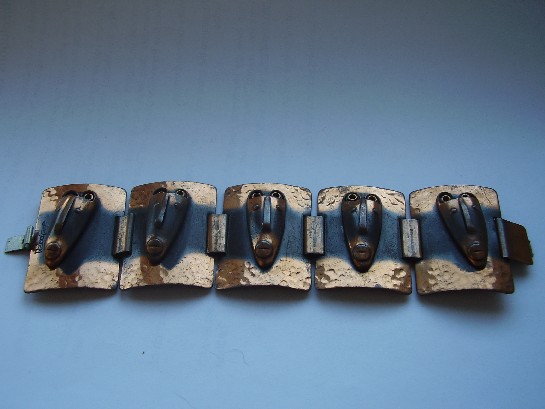
Frank Rebajes Copper Face Bracelet 1950's

In the 1930s, Frank Rebajes arrived in New York from the Dominican Republic with almost nothing, and started hand-forming copper jewellery on the street. By the 1950s, his Greenwich Village studio was one of the best-known names in American modernist metalwork, copper and brass pieces sold everywhere from his own shop to major department stores, worn by people who wanted something that looked nothing like traditional fine jewellery.

This bracelet is a good example of exactly what made his work distinctive. Five stylised faces, hammered and patinated copper, linked into a single articulated band. It’s not trying to be subtle. Rebajes’ whole design language ran on bold, abstracted forms rather than delicate detail, closer in spirit to the primitivist and folk-art influences popular in mid-century design than to anything from a traditional jeweller’s bench.

Why copper, specifically. Copper was cheap, workable by hand, and took a patina beautifully, all of which mattered to a designer building a business from nothing. It also meant Rebajes pieces were affordable enough to actually sell in volume, which is part of why they turn up reasonably often today, and part of why a genuine, well-preserved piece like this is still worth having: this was democratic design, made to be worn, not locked away.

What to look for. Genuine Rebajes pieces are usually stamped, and the patina should look earned rather than artificial, uneven, settled into the recesses of the hammering rather than a flat, uniform tone. This piece carries exactly that kind of honest age.

This piece has since sold. It was part of a small, genuinely personal collection of mid-century and antique jewellery, gathered over years rather than acquired for resale. See the Frank Rebajes Copper Face Bracelet on Gozotiques.