
Or: not every mid-century Mexican silver piece stayed within silver’s own colour range
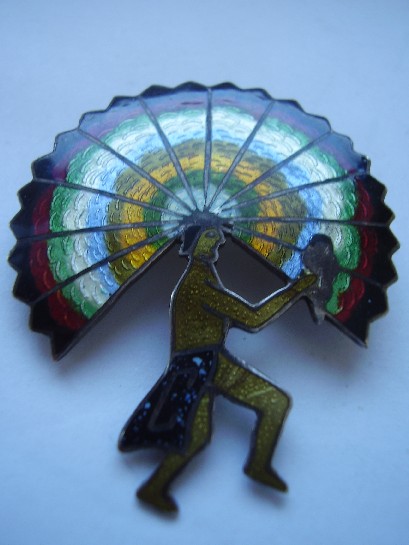
Most of Mexico’s mid-century modernist silver, Los Ballesteros and Holzerco among the names elsewhere in this collection, worked within silver’s own tonal range, letting form and surface texture carry the design rather than colour. Castelan’s enamelled work takes a different route: bright, fired colour applied directly onto the silverwork, bringing genuine colour into a design tradition that mostly didn’t reach for it.
Enamelling is an unforgiving technique, glass-based colour fused to metal at high heat, prone to cracking or discolouring if the underlying craftsmanship isn’t precise. A well-preserved enamelled piece from this period is a genuine test of both the original maker’s skill and how carefully the piece has been kept since. This brooch passes both tests: clean, vivid colour with no visible cracking or wear to the enamel surface.
Why colour changes the collecting calculus. An enamelled piece is inherently more fragile than a purely silverwork one, which makes surviving examples in genuinely good condition more significant than their monochrome counterparts, not less. Condition does more of the work in determining real value here than it does with plain silver.
What to look for. Enamel should sit flush with the metal, glossy and unbroken, with no visible hairline cracks radiating from the edges, exactly the condition this piece is in.
This piece has since sold. It was part of a small, genuinely personal collection of mid-century and antique jewellery, gathered over years rather than acquired for resale. See the Castelan Mexico brooch on Gozotiques.