
A Los Ballesteros Storyteller Bracelet, Circa 1950s: Mexico’s Silver Golden Age

Or: the workshop tradition that turned Taxco into a global silver capital
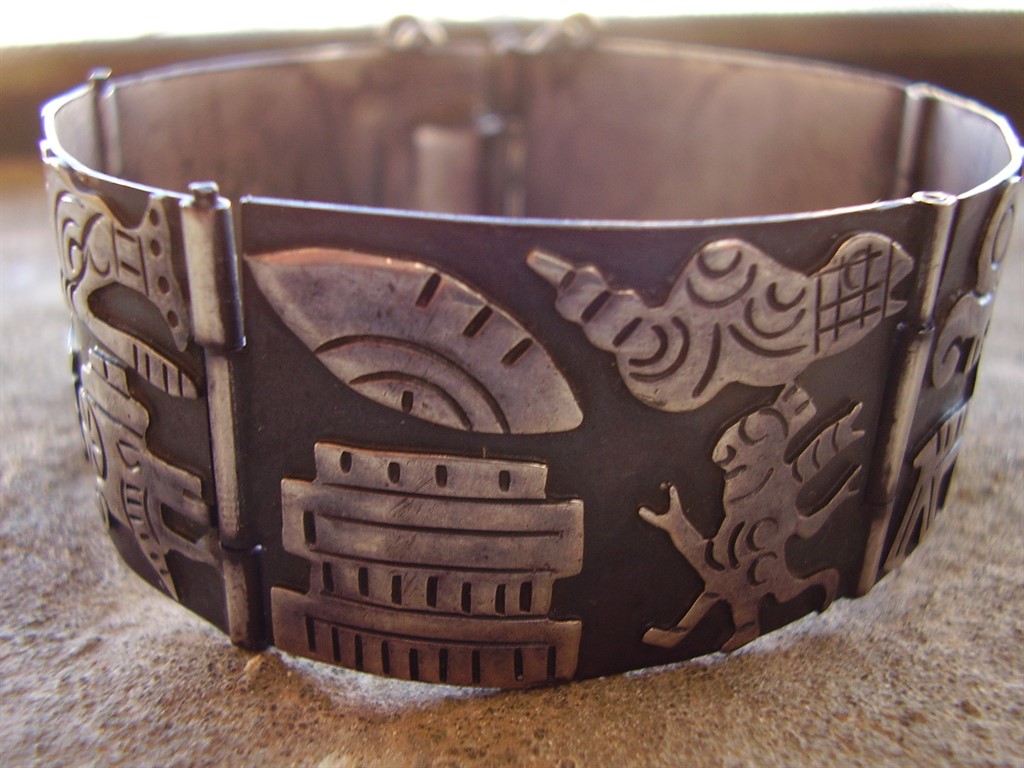
Los Ballesteros Storyteller Bracelet

Los Ballesteros is part of the wider Taxco silver tradition, the Mexican town that became, almost by accident, one of the 20th century’s genuine centres of modernist silver design after William Spratling established his workshop there in the 1930s, training a generation of Mexican silversmiths who went on to found their own studios. This bracelet, in the storyteller style, narrative imagery worked directly into the silver’s surface, carries that lineage forward.

The storyteller form is distinct from the purely abstract modernist work elsewhere in this collection, figurative panels that read almost like a sequence, drawing on Mexican folk narrative traditions rather than European abstraction. It’s a genuinely different design language from the Scandinavian pieces in this collection while sharing the same underlying mid-century confidence in silver as a serious design medium.

Why Taxco’s story matters here. What happened in Taxco from the 1930s onward wasn’t one workshop’s success, it was the creation of an entire regional silver industry, dozens of workshops training under and then branching out from Spratling’s original studio. A piece like this represents that whole ecosystem, not an isolated maker working alone.

What to look for. The narrative panels should show crisp, legible detail, and the piece should carry both the maker’s mark and Mexican silver content stamps, standard for genuine Taxco-tradition work of this period. Both are present and clear here.

This piece is part of a small, genuinely personal collection of mid-century jewellery, gathered over years rather than acquired for resale. See the Los Ballesteros storyteller bracelet on Gozotiques.
A Castelan Mexico Enamelled Brooch: Colour Enters the Modernist Story

Or: not every mid-century Mexican silver piece stayed within silver’s own colour range

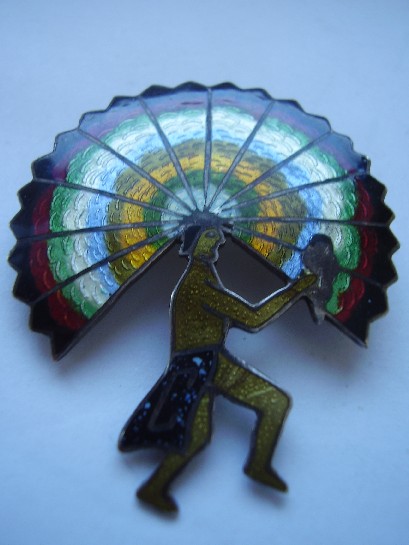
Castelan Mexico enamelled brooch

Most of Mexico’s mid-century modernist silver, Los Ballesteros and Holzerco among the names elsewhere in this collection, worked within silver’s own tonal range, letting form and surface texture carry the design rather than colour. Castelan’s enamelled work takes a different route: bright, fired colour applied directly onto the silverwork, bringing genuine colour into a design tradition that mostly didn’t reach for it.

Enamelling is an unforgiving technique, glass-based colour fused to metal at high heat, prone to cracking or discolouring if the underlying craftsmanship isn’t precise. A well-preserved enamelled piece from this period is a genuine test of both the original maker’s skill and how carefully the piece has been kept since. This brooch passes both tests: clean, vivid colour with no visible cracking or wear to the enamel surface.

Why colour changes the collecting calculus. An enamelled piece is inherently more fragile than a purely silverwork one, which makes surviving examples in genuinely good condition more significant than their monochrome counterparts, not less. Condition does more of the work in determining real value here than it does with plain silver.

What to look for. Enamel should sit flush with the metal, glossy and unbroken, with no visible hairline cracks radiating from the edges, exactly the condition this piece is in.

This piece has since sold. It was part of a small, genuinely personal collection of mid-century and antique jewellery, gathered over years rather than acquired for resale. See the Castelan Mexico brooch on Gozotiques.

A Holzerco Moebius Strip Bangle: Mexican Silver Meets Topology

Or: the jewellery form that’s technically a one-sided surface

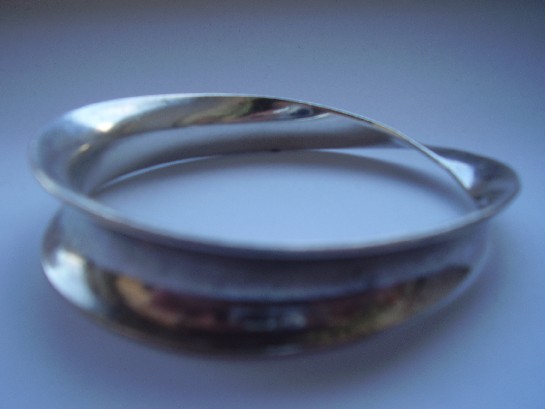
Holzerco Mexico Moebius strip silver bangle

A Möbius strip is a genuinely strange piece of mathematics before it’s ever a piece of jewellery, take a strip, give it a half-twist, join the ends, and the resulting surface has only one side and one edge. Trace a finger along it and you’ll cover both what looks like the front and the back without ever lifting off. It’s a favourite shape in mid-century design precisely because it looks impossible while being simple to actually make.

Holzerco, working out of Mexico, rendered it in silver as a bangle, and the effect works exactly as it should: turn it in the light and the surface seems to fold back on itself in a way that shouldn’t quite be possible for something so simple. This sits alongside Mexico’s broader mid-century silver movement, the same tradition that produced Los Ballesteros and other well-known workshops, all sharing an interest in form that reads as genuinely modern rather than decorative.

Why the Möbius form recurs across mid-century design. It shows up in jewellery, sculpture, and graphic design throughout the 1950s and 60s partly because it’s a rare case where a genuinely mathematical idea translates directly and legibly into a physical object, no abstraction required. Wearing one is, in a small way, wearing a piece of topology.

What to look for. The twist should be smooth and continuous, not a visibly joined seam trying to fake the effect, real Möbius-form pieces are shaped from a single continuous band. This one is genuine.

This piece has since sold. It was part of a small, genuinely personal collection of mid-century and antique jewellery, gathered over years rather than acquired for resale. See the Holzerco Möbius strip bangle on Gozotiques.