
Or: the jewellery form that’s technically a one-sided surface
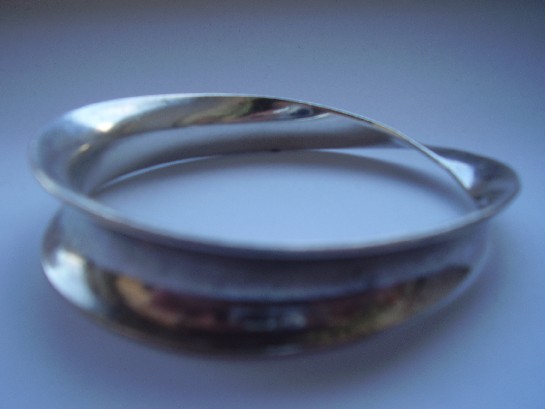
A Möbius strip is a genuinely strange piece of mathematics before it’s ever a piece of jewellery, take a strip, give it a half-twist, join the ends, and the resulting surface has only one side and one edge. Trace a finger along it and you’ll cover both what looks like the front and the back without ever lifting off. It’s a favourite shape in mid-century design precisely because it looks impossible while being simple to actually make.
Holzerco, working out of Mexico, rendered it in silver as a bangle, and the effect works exactly as it should: turn it in the light and the surface seems to fold back on itself in a way that shouldn’t quite be possible for something so simple. This sits alongside Mexico’s broader mid-century silver movement, the same tradition that produced Los Ballesteros and other well-known workshops, all sharing an interest in form that reads as genuinely modern rather than decorative.
Why the Möbius form recurs across mid-century design. It shows up in jewellery, sculpture, and graphic design throughout the 1950s and 60s partly because it’s a rare case where a genuinely mathematical idea translates directly and legibly into a physical object, no abstraction required. Wearing one is, in a small way, wearing a piece of topology.
What to look for. The twist should be smooth and continuous, not a visibly joined seam trying to fake the effect, real Möbius-form pieces are shaped from a single continuous band. This one is genuine.
This piece has since sold. It was part of a small, genuinely personal collection of mid-century and antique jewellery, gathered over years rather than acquired for resale. See the Holzerco Möbius strip bangle on Gozotiques.