Or: what a design movement looks like once it’s stopped experimenting and started perfecting

By 1974, Finnish modernist silver had nothing left to prove. The movement that Elis Kauppi and his contemporaries helped build through the 1950s and 60s had matured into a fully confident design language, and this ring, structural silverwork set with labradorite, shows exactly what that late-stage confidence looks like: no hesitation in the proportions, no uncertainty in how the stone is held, just a fully resolved design executed cleanly.
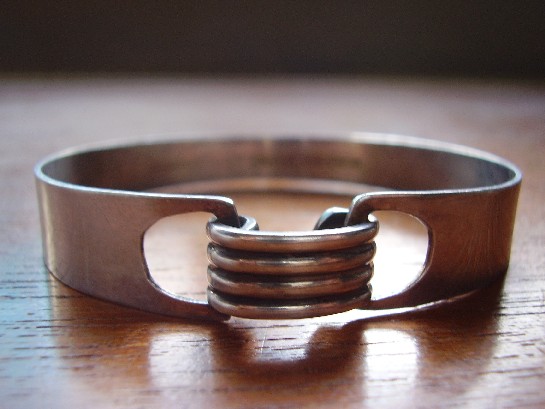
This piece sits usefully alongside the earlier Erik Granit bracelet in this collection, also dated, also Finnish, also 1970s, letting two independently made pieces from the same moment and movement effectively confirm each other. That kind of cross-reference is exactly how a private collection, built by someone paying real attention over years, ends up more useful to understand a design period than a single isolated purchase ever could.
Why the mid-1970s specifically matters for Finnish silver. This is arguably the design language at its peak maturity, after two decades of development but before the movement began fragmenting into more varied, less unified directions later in the decade. A dated 1974 piece is a genuine anchor point for understanding exactly where the movement stood at that moment.
What to look for. A clear date stamp alongside the maker’s mark, and labradorescence that shifts visibly in the light, both present and strong on this ring.
This piece is part of a small, genuinely personal collection of mid-century jewellery, gathered over years rather than acquired for resale. See the Finland Modernist ring on Gozotiques.