
A Matching Pair of Victorian Scottish Agate Earrings: The Original Souvenir Jewellery

Or: before there were fridge magnets, there was banded agate
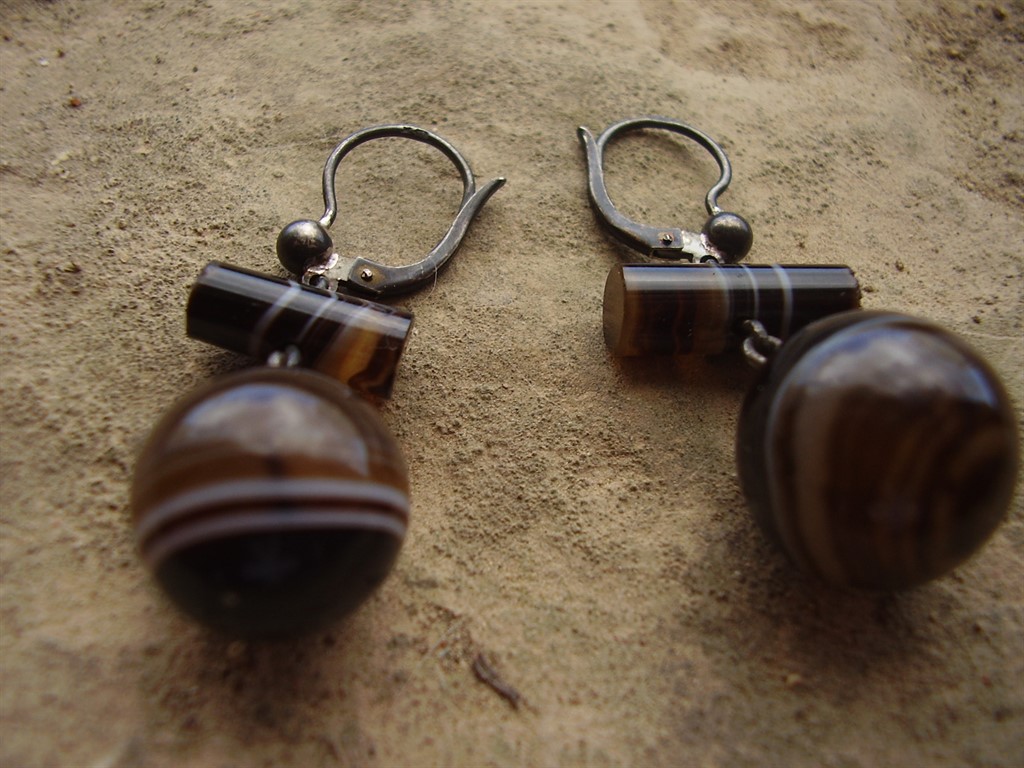
Matching Pair of Victorian Scottish Agate Earrings

Scottish agate jewellery became genuinely fashionable in the Victorian era largely because of one person: Queen Victoria’s well-documented fondness for the Scottish Highlands turned Balmoral and the surrounding region into a must-visit destination for wealthy Victorians, and agate, abundant in Scottish rivers and hillsides, became the era’s defining souvenir material. These earrings, showing the mineral’s natural banding, are a genuine example of that specific 19th-century tourism phenomenon rendered in wearable form.

What makes Scottish agate jewellery distinct from agate work elsewhere is the setting style, typically simple, sturdy metalwork that lets the stone’s natural banding do all the visual work, a world away from the elaborate gemstone settings of formal Victorian jewellery. This was accessible luxury, not court jewellery, which is exactly what made it so popular.

Why a matching pair matters. Earrings are among the easiest pieces to separate over a century and a half, one lost, one kept, one sold on its own. A genuinely matched surviving pair, with consistent banding and identical settings, is meaningfully harder to find intact than a single Victorian agate brooch or ring would be.

What to look for. The banding pattern should be closely, though not perfectly, matched between the two stones, natural agate is never identical piece to piece, but a genuine period pair was selected by an eye for reasonable consistency. These two are a good match.

This piece has since sold. It was part of a small, genuinely personal collection of antique jewellery, gathered over years rather than acquired for resale. See the Victorian Scottish agate earrings on Gozotiques.
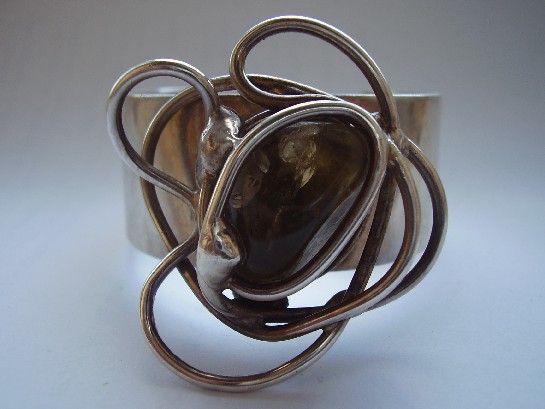
An Anette Borke Huge Agate Bangle: Denmark Working at Real Scale

Or: sometimes restraint means letting one enormous stone do all the talking

Anette Borke Denmark Huge Agate Bangle

Most of the mid-century Scandinavian silverwork in this collection makes its case through proportion and structure at a fairly modest scale. This bangle takes a different approach entirely: a genuinely large agate, banded in the mineral’s characteristic layered pattern, set as the whole point of the piece rather than one element among several. Anette Borke’s Danish workshop clearly understood that sometimes the most modernist decision available is simply to get out of the stone’s way.

Agate’s banding is entirely natural, no two stones cut the same way twice, which means a piece built around a stone this size is also, inevitably, a one-off. The silverwork here is confident enough to frame that scale without fighting it, structural rather than delicate, built to actually carry the visual weight of the stone rather than merely hold it in place.

Why scale itself is a design decision. A smaller stone in the same setting would read as a conventional bangle with a nice accent. At this size, the agate stops being decoration and becomes the actual subject, the same shift in thinking that separates a competent piece of jewellery from a genuinely confident one.

What to look for. The banding should show genuine natural variation and depth under light, rather than a flat, uniform colour that might suggest dyed or lower-grade material. This stone shows the real thing.

This piece has since sold. It was part of a small, genuinely personal collection of mid-century and antique jewellery, gathered over years rather than acquired for resale. See the Anette Borke agate bangle on Gozotiques.