Or: four pieces, four materials, one consistent hand
Erik Dennung’s work appears four times across this collection, and no two pieces share the same material or occasion. That range is itself the story worth telling: a designer confident enough in their own underlying structural logic to apply it to a genuine fossil, a retailer collaboration, classic pearl, and a purely functional adjustable ring, without any one of them reading as a compromise or an afterthought.
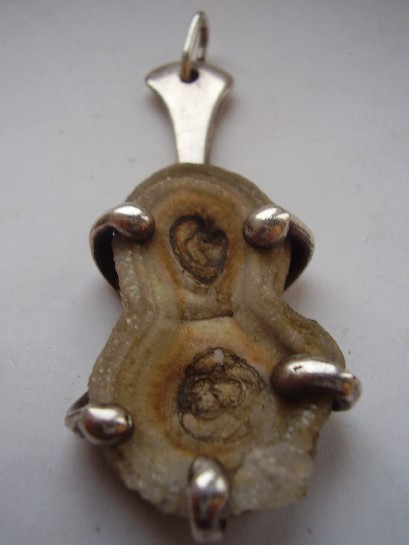
The fossil pendant is the boldest of the four, a genuine piece of geological history set in restrained silverwork that frames the fossil rather than competing with it, trusting the material to be interesting entirely on its own terms.
The pendant for Buch & Deichmann shows the commercial side of Danish mid-century design, a working designer producing pieces in direct collaboration with an established retail house, each lending the other credibility.
The silver and pearl bangle is the most conventionally elegant of the four, cleaner and more restrained than the fossil piece, proof that Dennung knew exactly when to let a material’s own lustre carry the design rather than asserting the silverwork over it.
The adjustable ring solves the least glamorous problem of the four, fixed sizing, but does it by building the adjustment into the ring’s own structural form rather than bolting on an obvious mechanism, the same underlying design discipline applied to a purely functional constraint.
Why range matters as much as signature. It’s easy to identify a designer by one recognisable trick, the way Kauppi’s kinetic pieces get discussed elsewhere in this collection. Dennung is a different kind of case: no single gimmick ties his work together, just a consistent structural confidence that holds steady whatever the material or the brief. That’s arguably a harder thing for a maker to sustain, and a more interesting one to actually collect across.
Explore the individual pieces: the fossil pendant, the pendant for Buch & Deichmann, the silver and pearl bangle, and the adjustable ring.