A Gebrüder Falk Art Nouveau Silver and Ruby Lizard Brooch: The Movement’s Favourite Reptile

Or: why lizards turn up constantly in Art Nouveau jewellery once you start looking

Alongside the insects, dragonflies especially, that define so much Art Nouveau jewellery, the lizard was another recurring subject the movement kept returning to. Its sinuous, curving body suited the era’s obsession with organic, flowing line better than almost any other creature available, a single lizard’s form could carry the whole visual vocabulary of the style in one continuous shape. This brooch, by the German house Gebrüder Falk, set with ruby accents, is a strong example of exactly that.

Gebrüder Falk, working in the same broad German Art Nouveau tradition as the guard chain elsewhere in this collection, brings the same combination this collection keeps returning to: precious material, silver and genuine ruby, handled with the movement’s naturalist sensibility rather than traditional formal jewellery’s more rigid symmetry. The lizard’s form curves and flows the way the era’s poster art and glasswork did too, the same visual language across entirely different media.

Why the lizard motif specifically rewarded a skilled silversmith. Unlike a symmetrical floral motif, a convincing lizard has to read correctly from every angle while still following the body’s actual anatomy, no cheating the proportions to make the metalwork easier. Getting both the naturalism and the flowing Art Nouveau line right simultaneously took real skill.

What to look for. The ruby settings should be secure and the silverwork’s line should read as a genuine, anatomically plausible lizard rather than an abstracted squiggle, both true of this piece.

This piece is part of a small, genuinely personal collection of antique jewellery, gathered over years rather than acquired for resale. See the Gebrüder Falk lizard brooch on Gozotiques.

[Image pending, to be added once source photo is confirmed.]
A French Art Nouveau Horn Fly Brooch by P. Lucas: Insects Were Never Beneath Art Nouveau

Or: the movement that found beauty in things most jewellers ignored

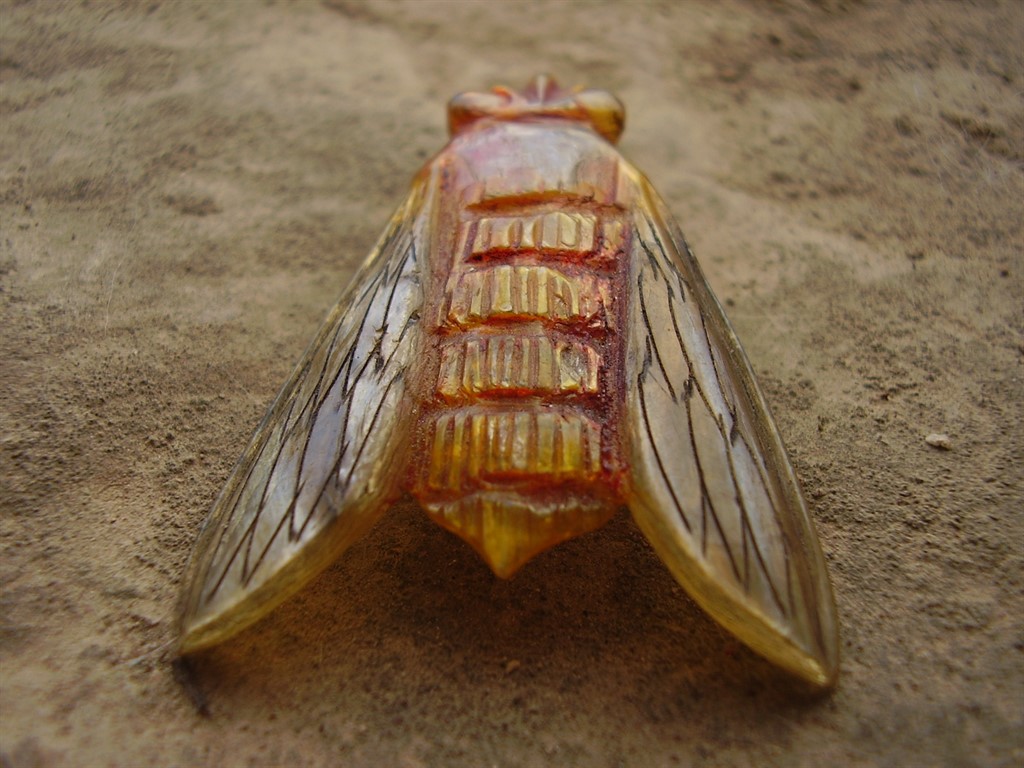
French Art Nouveau Horn Fly Brooch by P. Lucas

Art Nouveau’s obsession with insects, dragonflies, beetles, and here, a fly, wasn’t a novelty act. The movement’s core belief was that nature itself, studied closely rather than idealised, was the richest possible source of design, and insects offered structural and textural complexity that flowers alone couldn’t match. A fly is an odd choice by conventional Victorian standards, but entirely within Art Nouveau’s actual logic: study the form honestly, then render it beautifully.

Horn as a material matters here too. Carved and moulded horn became one of Art Nouveau’s signature materials specifically because it could be worked into translucent, organic forms that precious metal alone couldn’t achieve, closer in spirit to the material experimentation of Lalique’s glass work than to conventional jewellery-making. P. Lucas’s fly, rendered in horn, uses exactly that translucency to catch light the way an actual insect’s wings would.

Why an insect subject was a genuinely bold choice. Choosing a fly rather than a butterfly or dragonfly, both far more conventionally ‘pretty’ insect subjects, signals a maker genuinely committed to the movement’s naturalist philosophy rather than just borrowing its decorative vocabulary. This wasn’t the safe choice.

What to look for. The horn should show genuine natural translucency and grain rather than the uniform opacity of a later plastic imitation, and the maker’s mark should be clearly legible. Both hold up here.

This piece is part of a small, genuinely personal collection of antique jewellery, gathered over years rather than acquired for resale. See the French Art Nouveau horn fly brooch on Gozotiques.

A German Art Nouveau Guard Chain: Maidens, Rubies, and the End of the 19th Century

Or: the last gasp of Victorian symbolism before the world went modern

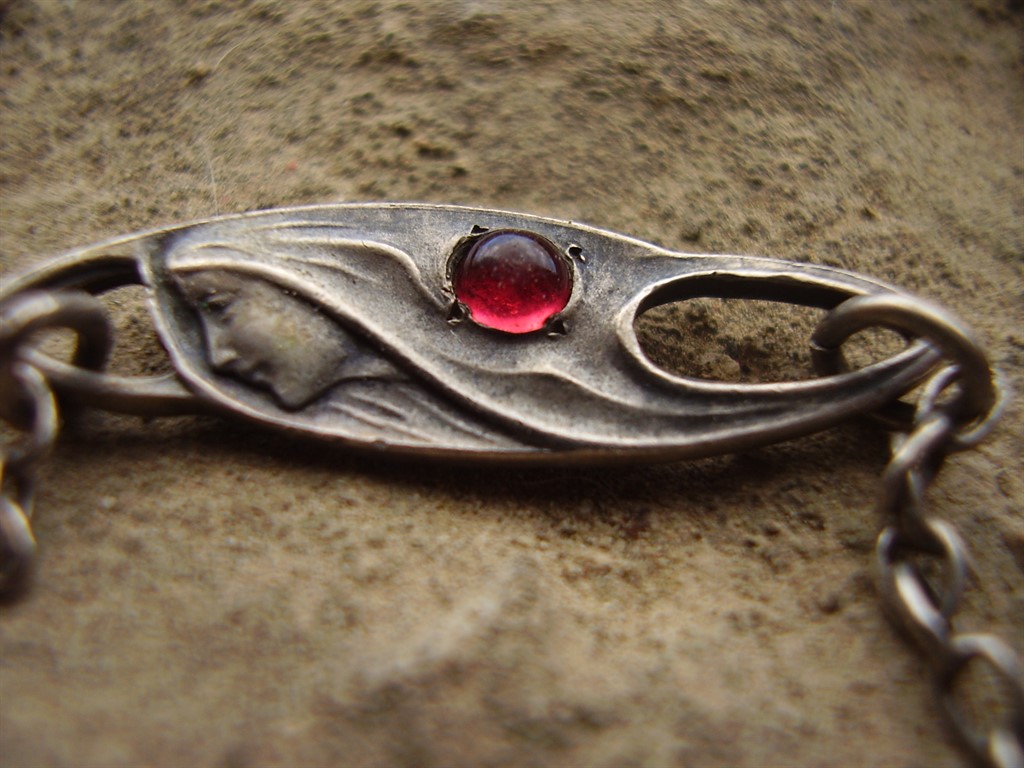
German silver and ruby Art Nouveau guard chain or necklace depicting maidens' heads

Art Nouveau jewellery sits at an odd hinge point in design history. It’s reacting against the heavy, mass-produced Victorian jewellery that came before it, reaching instead for flowing natural forms, maidens, flora, insects, but it’s still working in precious metal and stone, still fundamentally a luxury craft. This German silver and ruby guard chain, depicting maidens’ heads, sits right at that hinge, ornate enough to be unmistakably late 19th century, but already reaching for the organic, figurative style that would define the movement.

A guard chain, worth explaining for anyone who hasn’t handled one, was originally functional: a secondary chain attached to a pocket watch, worn as insurance against losing the watch itself, often doubling as a necklace or fastened across a bodice. By the late 19th century they’d become a genuine display piece in their own right, sometimes more elaborate than the watch they were nominally guarding.

Why the maiden motif, specifically. Figurative female faces, often stylised or half-abstracted into the metalwork itself, were one of Art Nouveau’s most recognisable signatures, echoing the same visual language found in the movement’s posters and glasswork. Finding it rendered this precisely in silver, rather than the more common base-metal costume pieces of the era, marks this as a genuinely well-made example rather than mass production.

What to look for. The ruby accents are set, not glued, and the facial detailing on the maidens’ heads is crisp rather than worn to a blur, both signs this has been kept properly rather than knocking around a drawer for a century.

This piece is part of a small, genuinely personal collection of antique jewellery, gathered over years rather than acquired for resale. See the German Art Nouveau guard chain on Gozotiques.